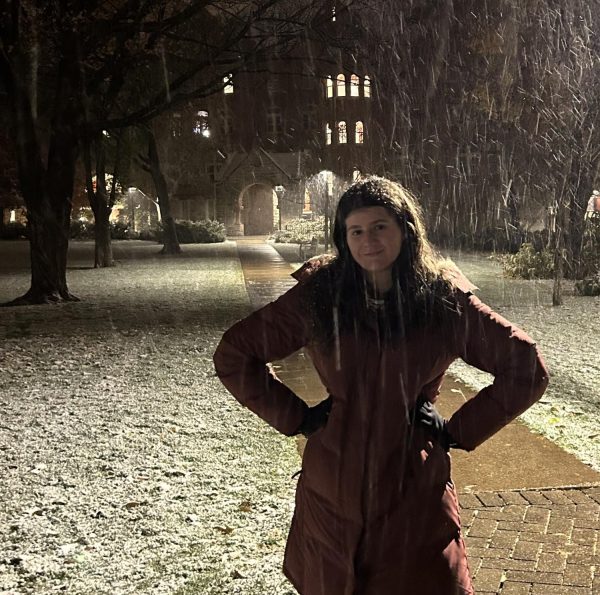
The Mac Weekly sat down with newly elected Macalester College Student Government (MCSG) President David Christenfeld ’27 to discuss his history with MCSG and his goals for his presidency. The interview has been edited for readability and length.
What motivated you to first get involved in MCSG, and what made you stick with it?
I was at a student org budgeting session because I had restarted Ping Pong Club my [first year], and the FAC [Financial Affairs Committee] chair at the time, Eliora [Hansonbrook ’25], said, ‘We’re looking for at-large members. We’d love people to join the FAC and come make these budget decisions.’ And I went up and asked if, as an org leader, I could [join] as well. She said, ‘Yeah, that would be great.’ … So I applied, I got accepted, and I really, just honestly fell in love with the FAC.
The next year, I said, ‘Well, I have to join MCSG.’ I ran, and I got elected. I joined the FAC again, and then I was under Luke Evans [’26], who was the chair. And halfway through, Luke told me that he had gotten an internship for a second semester, and so he was leaving, and he wanted me to fill in the role of chair.
I think what really made me stay [was] I felt that MCSG did super important work, but it wasn’t necessarily the work that was being seen around campus, and I thought that could change.
Can you tell me more about what it means to fall in love with the FAC? Because, from my side, the ‘Financial Affairs Committee’ is not usually the place you’d fall in love with.
Yeah, I get that a lot. I think the FAC has a difficult job. Giving away as much money as possible by making sure that everything we’re giving away follows the code, follows our past precedent and that it’s equitable. I thought it was the perfect place to really have a tangible impact on clubs. I think clubs really make Macalester what it is — all the events that we see, amazing events, stuff like The Mac Weekly, this all comes through there. And so I think it was a super tangible impact.
What do you think have been your biggest successes in your time at MCSG? What have been your biggest challenges?
Looking at the challenges first, I think it’s been a super challenging time for the FAC. We had the biggest budget deficit in the history of the committee. We had over $250,000 of requests, and almost $70,000 to give away. That was just devastating, and I think that showed me how much we need to change. So I think my biggest success was the increase of the student activity fee and the switch to semesterly budgeting.
I think those have also been challenges because at face value, they’re not super popular. Nobody wants their tuition to go up, and so being the one to kind of spearhead that is [difficult]. I don’t want to put an unnecessary burden on people who are already struggling, which is why I prioritized conversations with people like [Assistant Vice President of Admissions and Financial Aid] Brian Lindeman [’89] and [Vice President for Administration and Finance] Patricia Langer to make sure that financial aid would be covering any increases in the student activity fee. We got confirmation that, as with all financial aid, it would be on a needbased scale. Those with the most need would be 100% covered.
I think that was really my biggest success: making the Budget Bonanza process worth doing again. It had been 13 years since we last increased the student activity fee, and it felt like it. We were miles below any of our Peer 40 [Colleges]. If it continued like that for one more year, we would have used up all of the savings we had built during COVID, and I can’t even imagine — we probably wouldn’t have hosted a Budget Bonanza.
What drove you to run for president?
I think in some ways, it was the next logical step for the change I wanted to make. I had made the changes I really wanted to see in the FAC, and the next changes I wanted to address were larger scale. … I was talking with Liv Peterson [’27], who’s [been elected] the Vice President, and we’ve been working together super closely as FAC and [Student Organizations Committee] SOC chair, and so we had super similar ideas about where we wanted to see it [go].
What are your biggest priorities for your presidency?
One smaller one is getting more people engaged in campus committees. I think they’re so underrated. I think people complain about shared governance, but what people miss is that in shared governance, you have to do the governance. The governance can be boring, but the doorways it opens are insane. Tying campus committees not with what they do, but what they can do, is really the way to do that. If you tell people, ‘[Educational Policy and Governance committee] EPAG is a committee that talks about academic affairs and grading,’ the amount of people who want to do that is super limited. But if you say, ‘If you care about getting music lessons cheaper, getting pass/fail for major requirements, this is the committee to do it,’ you can direct people who have strong passions for specific projects into the right places.
The biggest goal is restructuring the class representative role. Right now we have four [class representatives] a year, and while their input on the committees is huge, there’s not that much to the role beyond their committee work. A lot of them have wanted to do things, and I think it’s just about whether they know how to do these things and whether they have the support they need. I’m hoping, right at the beginning of the year, I can change the class representative role and get them in teams working on class projects.
The third [goal] would be empowering MCSG committees to use the additional allocations system. I think right now, we have committees like the [Communications and Engagement Committee] CEC who want to put on large events, get the whole campus into it, but there’s just no money in the budget for it. And so I’ve told our current CEC chair that we should be using the FAC pool more, as long as that comes with the understanding that it’s not going to be automatic, and that you have to go through the same process that everybody goes through.
How do you characterize yourself as a leader? And who are your biggest inspirations as a leader, at Macalester and in a broader sense?
As a leader, I’m somebody who likes feedback. I get very frustrated when we’re engaging in projects that we think people want. … We have a super strong team going into next year for the Exec Board. … Going in and making sure I have strong people supporting me, and I’m supporting other strong people. That is definitely the type of leader I am.
Some inspirations: I have to say, [Associate Director of Leadership & Orientation] Emi Menk has taught me so much about leadership, both leadership theory and also just what it means to actually go out and be a tangible leader. [Student Organizations Coordinator] Garrett [Meier] and [Executive Director of the CSLE] Laurie [Adamson] as well.
Outside of Mac, I have to say — maybe it’s a cheesy answer — but my mom is definitely my biggest inspiration. She was a management consultant for a long time, and I think seeing the work she put into that, being gone most of the time, coming back some weekends. I think she showed me what a work ethic really is, and I’m very, very grateful to be in the position I am because of the work she did. I really can’t thank her enough for that.
What do you believe is the role of MCSG in the Macalester community?
Primarily, we should be representing student interests, not MCSG interests. Going around, getting feedback, that’s really our role. We act as a bridge between administration and the students, so maintaining relationships with both [is important]. Knowing when to push back against administration is an MCSG role, knowing when to really encourage the student body to vocalize their concerns and to be a platform in which that can happen at a large scale.
Being on MCSG gives us the opportunity to have conversations with a lot of the [Senior Leadership Team] SLT. Using time in those rooms and those conversations to talk about what students actually care about is really the role of MCSG.
I think the biggest thing that MCSG does — maybe this is definitely biased as an FAC person — is supporting student orgs. … I think that’s really the most tangible day to day work.
If your presidency is a total success, what does it look like? What are your stretch goals?
There’s a whole bunch of students who have a lot of research they want to show, and they want to go to conferences. And right now, even with the student activity fee increase, those conferences are so expensive. And our current conference fund (which is run by an academic department) is super helpful, but it’s not well funded. It doesn’t have enough to really provide people with what they need. And so one dream goal of mine would be to better support students trying to present their research at academic conferences.
Is there anything else you want to add?
I want to say thank you to Galjer Yangwaue [’27, who ran against Christenfeld]. I think she would have done an amazing job as well.
And thank you to everybody who came out and voted. The turnout was huge.