This story discusses the passing of Binta Maina ’26. This loss is still fresh for many and has impacted the campus community in different ways. For a list of support resources on and off campus, please visit themacweekly.com/resources/.
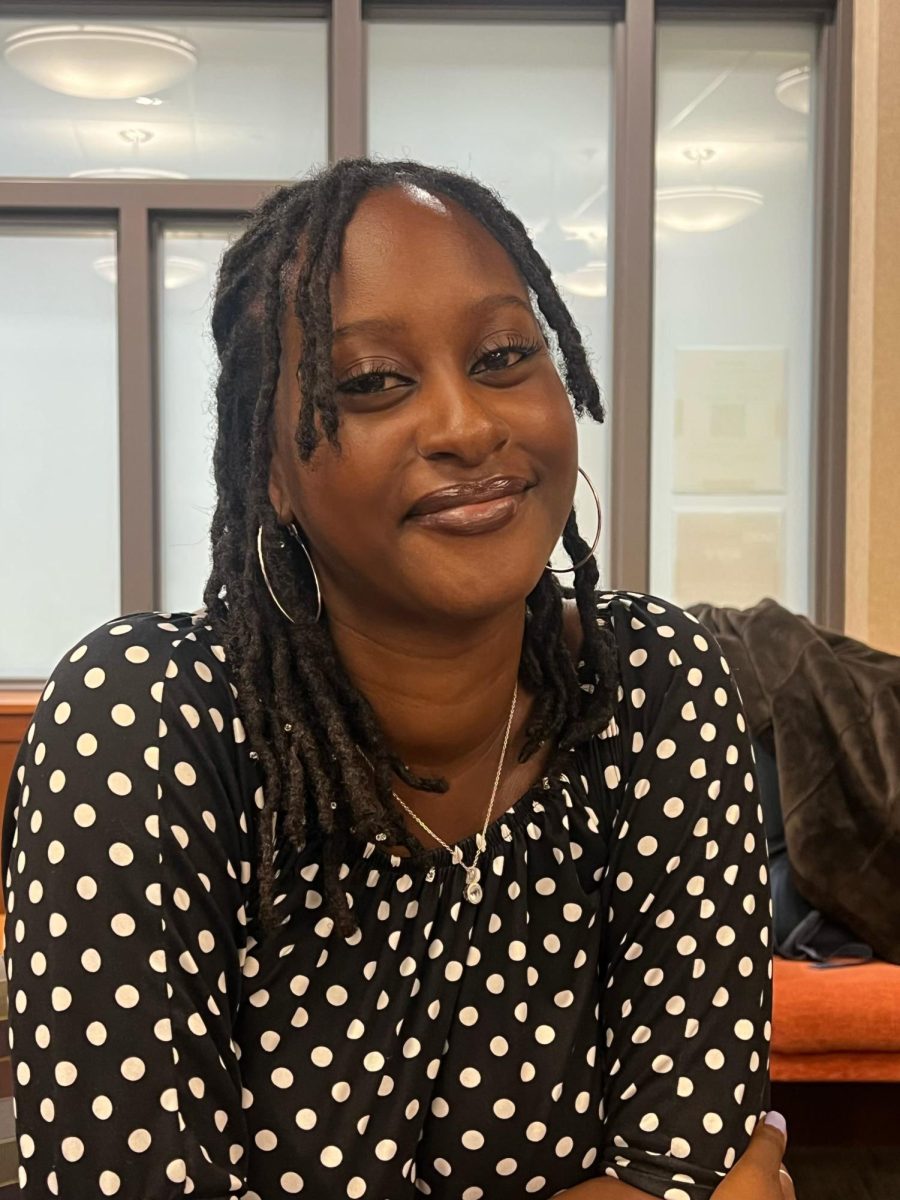
By all accounts, Binta Maina ’26 knew how to light up a room.
“She had a really radiant personality that a lot of people were lucky enough to get to experience,” her brother Bockarie Maina ’26 said. “[Binta was] very family-oriented. I think I recognize that more now than I did when she was still here, and I kind of took it for granted. But for me, she was the core of our family.”
On Nov. 12, 2025, President Suzanne Rivera announced Binta’s passing in an email to the Macalester community. Binta was a triplet and is survived by her brothers Bockarie Maina ’26 and Ondieki Maina ’26, who both attend Macalester, as well as her older sister, Ouyanatu Maina, and her parents, Samuel and Isha Maina.
The day following the announcement, the college hosted a candlelight vigil in her honor outside the Campus Center. Throughout the week, students filled out cards and left flowers for the Maina family. On Thursday, Nov. 20, 2025, the college hosted a memorial service in the Weyerhaeuser Memorial Chapel.
In her time at Macalester, Binta double-majored in biology and neuroscience, with a psychology minor and an undeclared history minor. Some of the areas Binta enjoyed studying and spending time with friends and family now hold memorials for her, including in the Olin-Rice Science Center and Old Main. The biology and chemistry departments have both set up memorials near their respective offices.
Before coming to Minnesota from Kensington, Calif., Bockarie and Ondieki were recruited to play for the Macalester men’s soccer team and had already committed when Binta was making her decision about college. She applied to the University of California schools and other liberal arts colleges, but also to Macalester, because it didn’t have an application fee.
“Then randomly, one day, Bock[arie] and I were sitting at the table, and we were talking to our mom, and then Binta came out of her room,” Ondieki said. “She was like, ‘I think I’m gonna go to Mac.’ And Bock[arie] and I were cracking on her, making jokes, like, ‘Bro, you want to go to school with us that badly? You have a bunch of other choices.’”
Binta’s decision may have seemed abrupt to her family, but she had researched the school and was steadfast. So, the triplets stayed together for college. Despite their jokes, her brothers appreciated having their sister with them.
“In my heart of hearts, I believe she came here to watch over me and my brother,” Bockarie said. “And in many ways, while she was here, she did … But also, I think she wanted to come here out of her own volition.”
Bockarie, also a biology major, took classes with Binta, and the siblings worked in the Emergency Care Consultants’ Scribe Program for students interested in healthcare professions.
Biology Professor Mary Heskel, who served as Binta’s advisor, recalled often seeing Binta and Bockarie studying together in Olin-Rice.
“I could see them lean on each other, for some of the harder science classes,” Heskel said.
Having advised Binta since her first-year course, Heskel shared that one of the lessons Binta taught her was the importance of family.
“I’ve found that people across all ages, but often in college … can kind of push their families further away, because you’re defining yourself as an individual,” Heskel said. “And it does not seem like she was doing that. It felt like she used her time at school to become even closer [to them]. That’s really aspirational, to want that closeness from the people in your life.”
Binta would call her family members every day when she was at school, sometimes multiple times a day. She would often call her older sister, Ouyanatu, while Ouyanatu was driving home from work.
“[We’d discuss] anything: small problems, big problems,” Ouyanatu said. “She listened, and she … would provide very simple or very easy and honest feedback or advice. But she also just cares — or she would care. She cared a lot about what we were going through. She would check in on us all the time. She’d make us laugh. That’s a good distraction. It makes things not seem as big as they are or puts things into perspective.”
In addition to her scientific studies, Binta had a passion for African history, which led her to take classes with Tara Hollies, a visiting assistant professor in the history department. Binta’s impact on Hollies was immediate.
“I’ve only had my PhD for five years, and I think her first year was my second year, and nobody knew who I was,” Hollies said. “She took all these classes with me, and I’d try to make a joke, and Gen Z[ers] don’t always get my jokes … but she would always do a little smile or give me a chuckle, and I could look at her if everyone was silent, and she’d smile … like, ‘You’re not crazy. Just keep going. It’s okay.’”
Binta took all five of Hollies’ courses — every African history class offered on campus. This was enough for the minor, though she never declared. Hollies said that Binta took more African history classes than anyone else at Macalester in that time, including history majors. She also convinced many of her friends to take Hollies’ classes.
“I know she was very popular, had a lot of friends and had a lot of influence,” Hollies said. “I can’t say the exact number, but I know that she — either directly or indirectly — influenced a lot of people on campus to take my classes. So, that impact[ed] me personally. I still have a job because I’ve had enough people take my classes that the college is like, ‘Oh, we should keep African history. I guess we could hire Tara [Hollies] for another year.’”
The last time Hollies and Binta saw each other was in passing, on a foggy fall morning. Hollies was coming into campus, and Binta was strolling to class, probably a little late for her 8:30 a.m. course, Hollies thinks.
“[She] didn’t say anything, just a smile and a wave,” Hollies said. “That is the memory that’s burned into my mind, because … anywhere I’d see her on campus, she’d always just smile, wave or say ‘hi.’ That [was the] kindness that she exuded.”
Binta’s brothers confirmed that Hollies was not alone in that experience. Their sister had a reputation for being a welcoming presence at Mac.
“I’d always be surprised [at] how many people she’d say ‘hi’ to when I’d walk through campus with her,” Ondieki said. “In my head, I’d be thinking, ‘I’ve genuinely never seen you talk to this person, or I don’t even know that person’ … She’d be like, ‘Oh, I had such-and-such class with them.’ [I’d say], ‘Oh, so you’re like, friends with them.’ She was like, ‘No, I just had class with them’ … I couldn’t comprehend why she would say ‘hi’ to the person, but that’s just who she was.”
Binta was also known for her sense of style. Ouyanatu remembers that Binta dressed according to her own stylistic vision.
“She had a very cutesy style, but she would serve when necessary,” Ouyanatu said. “Day-to-day, it could change: she could be in a more calm mood, or like, ‘I really want to dress up today,’ or ‘I’ve had this outfit in mind, and I’m gonna wear that.’ And she wore whatever she wanted whenever. It wasn’t like, ‘Oh, it’s cold today. I’m not gonna wear this.’ That did not matter to her.”
Before she passed, Binta, Ouyanatu and their mother had sponsored five students with financial need at the Government Secondary School for Girls Mathora in Magburaka, Sierra Leone. Now, to expand that work, her family has established The Binta Maina Memorial Scholarship Fund.
“Our mom was born in Sierra Leone, and in her father’s tribe, girls weren’t allowed to go to school,” Ondieki said. “My mother had to essentially plead and beg to go to school … So, her emphasis on education — understanding that education is a privilege — is something that’s been instilled in us from a very young age. Giving people [the] opportunity who wouldn’t otherwise have it to go to school is something that we’ve always found very important.”
The fund also provides a way to preserve Binta’s memory at Macalester, even after the friends and professors she knew at the school are long gone.
“I had dreams of the three of us walking across the stage at graduation, and now it’s just not going to be the case,” Bockarie said. “For me, personally, I find it important to … cement her here in some way. The rock outside is painted and has her name on it, but in a few years, that probably won’t be the case — or [in a] few months, maybe. After this year’s first-years graduate, no current students are going to know who she is. So, who’s going to be there to keep her spirit and name alive here?”
Amongst her family and friends, Binta will be remembered for the way she lived her life. She went at her own pace, was honest with others about the way she felt, and above all else, she cared.
“I think she was the kindest person to people that she didn’t know,” Ondieki said. “[If] she walked past someone that she didn’t know, but it seemed like they were having a bad day, she’d smile at them or wave.”
Binta had a few sayings that she loved, including “YOLO” (You Only Live Once) and “It’s not that deep.” She spent much of her life reminding others — through both words and actions — to enjoy their time together.
“[She was] genuine, funny, kind, caring — just full of life,” Ouyanatu said. “It’s cliche, but she literally embodied ‘live, laugh, love.’ She lived to the fullest. She did things that she wanted to do, and she laughed a lot. She loved her friends and her family deeply.”
Donate to The Binta Maina Memorial Scholarship Fund at gofundme.com/f/support-binta-maina.