Editor’s note: A previous version of this article stated that Alex Pretti was fatally shot by two ICE agents. Pretti was fatally shot by a CBP officer and Border Patrol agent.
On Jan. 30, thousands of Minnesotans called off work and school and rallied in downtown Minneapolis in protest of President Donald Trump’s nationwide immigration crackdown for the second Friday in a row.
This time, Minnesota’s general strike went national. Businesses in the Twin Cities and across the country closed for the day, as demonstrators in Los Angeles, New York, San Francisco, Chicago and Detroit joined in chanting phrases decrying the presence of Immigration and Customs Enforcement (ICE), such as “ICE Out” and “No hate, no fear, immigrants are welcome here.”
The downtown Minneapolis rally, which was scheduled to begin at 2 p.m., kicked off at the Hennepin County Government Center. The demonstration reached the U.S. Bank Stadium at around 3:30 p.m.
To Fred Welsh, 58, this protest felt more intense than last week’s.
“I think people are angrier, and nothing’s changed,” Welsh said.
This January, ICE held an estimated 73,000 individuals in its detention centers, more than ever before. On Saturday — one day after the protest — a federal judge ordered the release of five-year-old Liam Conejo Ramos, who was detained in his driveway in Columbia Heights, Minn. while returning from school. However, Minnesota Public Radio reports that children and adults continue to be detained by ICE and transported out of state before Minnesota’s federal courts can issue an injunction to pause deportation orders.
The Jan. 23 general strike and rallies demanded justice for Renée Macklin Good, who was killed by an ICE agent on Jan. 7. The morning after the Jan. 23 general strike, Customs and Border Protection (CBP) officer and Border Patrol agent fatally shot Alex Pretti.
Some in attendance felt Pretti’s loss personally. Donnie McMillan, who is 71 years old and worked as a military dog handler for 16 years, is among the patients whom Pretti served as a nurse at the Veterans’ Association (VA).
“I was a cop,” McMillan said. “This is not the way we handle things. It’s ridiculous. My heart is broken for Alex [Pretti]. He was one of my angels at the VA hospital. I go out there three days a week for treatment. I’m wounded and healing, but they’re helping me.”
While the surge of ICE activity is literally close to home for many in the Twin Cities, the ripples have reached people across the nation and around the globe, a reach that demonstration attendance reflected.
Frank Merrit, 41, traveled to Minneapolis from the United Kingdom in the wake of Good’s killing to participate in protests and strikes.
“We all now live under Trump,” Merrit said. “Obviously, he’s more direct and more oppressive in the United States, but the world is in his sphere of influence, and we need to fight back against it because our government in Britain is looking to appease racism, looking to appease attacks on immigration. We’ve got a party in Britain called Reform [UK]; they love ICE. ”
At the same time, Merrit said, he was optimistic about the protesters’ odds.
“I’m absolutely certain that working-class people in America will drive ICE into the dust,” Merrit said. “It’ll take time. It’ll take sacrifice. There’ll be many battles and struggles. But … the ruling class is terrified of what they’ve built in terms of an unequal, rotten society that’s coming back to haunt them.”
While recent American protests have attracted some international travelers like Merrit, countries outside the U.S. have begun staging their own anti-ICE demonstrations. In Milan, protesters took to the streets on Jan. 31, following news that a specialized unit of ICE would be present at the 2026 Winter Olympics.
In Minneapolis, many attendees brought signs, and others stood at corners and on the sidelines throughout the march route with hand warmers, snacks, warm drinks, masks and “know your rights” materials. Charlotte, 31, who asked to be referred to by her first name only due to personal safety concerns, and her family brought egg rolls, made at home the night before.
“Food is a universal love language, and I feel like this is a way that we could help take care of our neighbors by being part of the protest and also making sure everyone’s warm and full,” Charlotte said.
Yubi Hassan, the 24-year-old founder and owner of Somali tea brand BlueHorn Tea, was among those offering warm drinks. Hassan gave out freshly brewed tea as well as sample bags for protesters to take home. He also emphasized that supporting Somali businesses helps combat the disproportionate targeting of Somalis by federal agents and the racist rhetoric that Trump has used to describe Minnesota’s Somali community.
“Seeing all these many people out here gives me reassurance that we’re not alone, and people genuinely do want us here,” Hassan said.
For Lisa Creteau, who was raised in Minneapolis, this march was just one day of action in a continued effort to call for federal agents to withdraw from Minnesota and end Trump’s aggressive immigration enforcement in the state.
“What they’re doing is unconstitutional and illegal, and I’m going to be fighting it until it’s over,” Creteau said. “I can’t stay home. I can’t look away. We’re volunteering, we’re rallying, we’re doing everything that we can do. We try to do something every day to try to make a difference because it’s overwhelmingly evil and wrong.”
McMillan feels similarly: “I feel like a piece of humanity’s been taken off the shelf and broken, and we have to do what we can to restore that.”
- [email protected]
- [email protected]
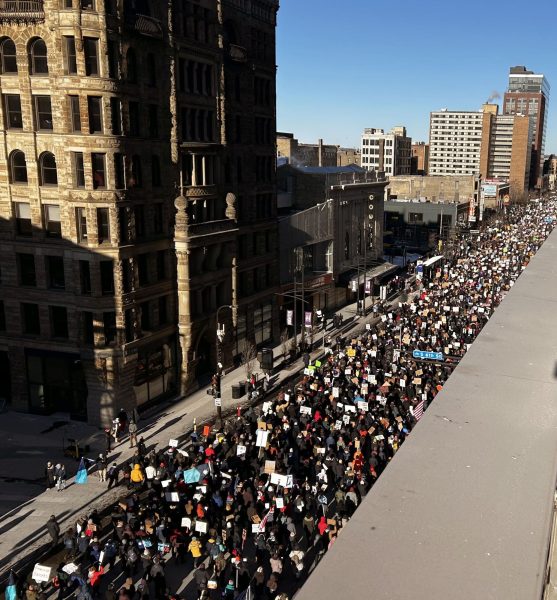
Photo by Callisto Martinez ’26 (Callisto Martinez) 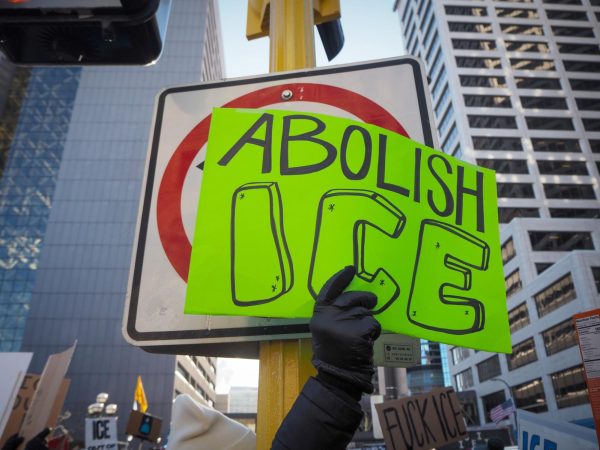
Photo by Allie Dodero ’28 (Allie Dodero) 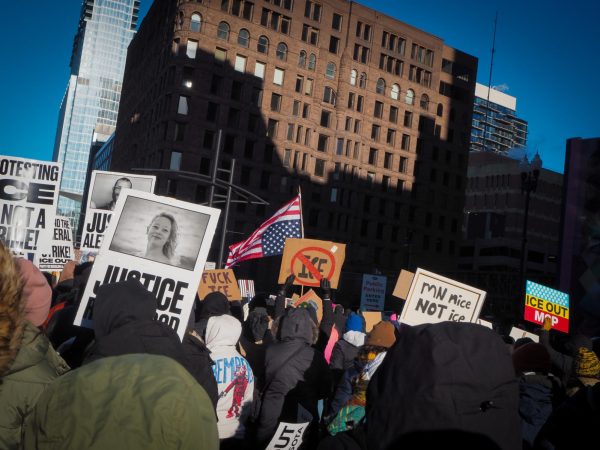
Photo by Allie Dodero ’28 (Allie Dodero)