*This review contains spoilers.
Pixar is back. “Hoppers” is the highest rated Pixar movie on Rotten Tomatoes since “Toy Story 4” in 2019, and it lives up to the billing. By going back to a staple of Pixar animation — talking animals with wild and wacky plots mixed with beautiful animation -– Pixar has made its latest classic.
“Hoppers” is also more directly political than many other Pixar movies, to mixed results. It has a fantastic, direct message addressing the importance of ecological preservation, to the point where even my seven year old cousin picked up on it. But the overarching plot suggests radical action against injustice is unjustifiable and emphasizes the importance of demanding change only when it is convenient for institutions.
The story is set in the fictional city of Beaverton and focuses on young human Mabel Tanaka (Piper Curda). We are introduced to Mabel as she tries to release all the animals in her elementary school into the wild. In the aftermath, Mabel’s grandmother Grandma Tanaka (Karen Huie) introduces Mabel to a glade near her home, saying “It’s hard to be mad when you feel like you’re part of something big.”
The moment of connection between Mabel and Grandma Tanaka in the glade is one of the shining moments of the movie. The animators make a point to contrast the city of Beaverton, filled with mostly muted gray buildings, with the natural beauty of the glade, and its gorgeous yellow and red autumnal shades, blue skies and water and vibrant green forest floor. The glade is a place Mabel feels safe to let go of her frustrations and be present with the nature around her — her happy place.
Fast forward a few years, and as a 19 year old student at Beaverton University, Mabel still loves her glade. She is now an avid conservationist, and is forced to defend her beloved glade from selfish Mayor Jerry West (Jon Hamm), who wants to put a highway through it. Luckily for her, she stumbles into the research of slightly mad scientist Dr. Samantha Fairfax (Kathy Najimy), who has discovered a way to put human consciousness into animatronic animals. Mabel takes over the equipment, and takes on a beaver persona to save the glade.
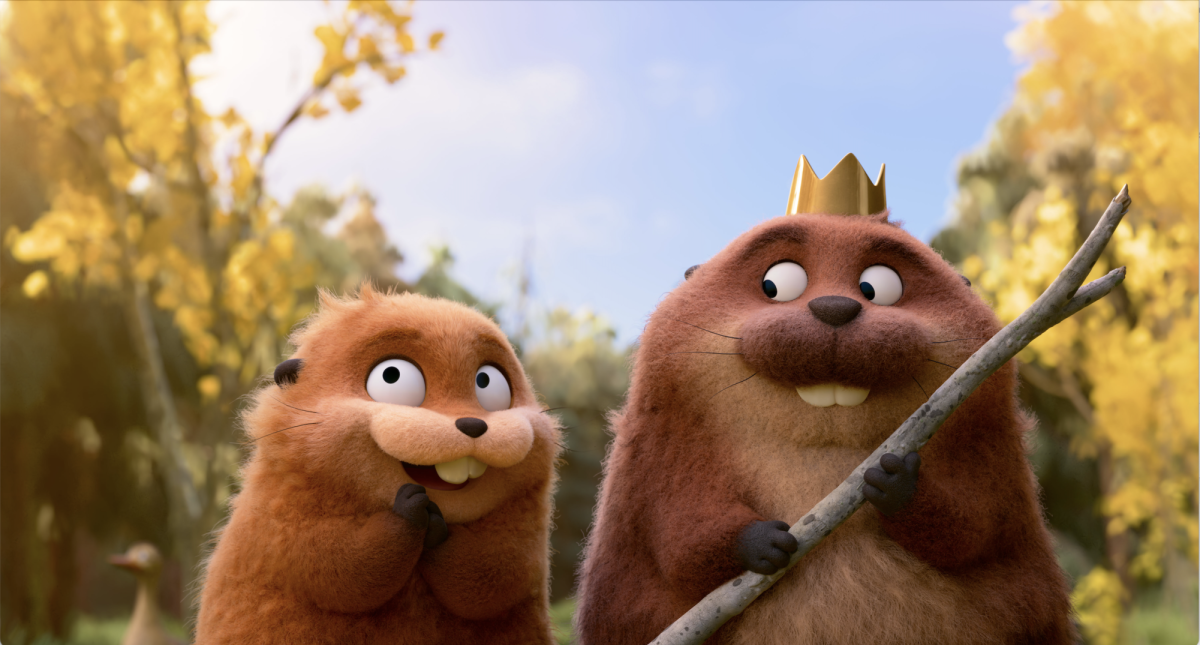
As a beaver, Mabel discovers she can speak to animals, and quickly earns the trust of the king of the mammals, a beaver named King George (Bobby Moynihan). As George’s newly anointed second in command, Mabel pressures King George to call on the Animal Council to take drastic action to prevent the glade from being destroyed. The Animal Council agrees, and led by the Insect Queen (Meryl Streep), they plan to squish (the animals’ word for “kill”) Jerry.
At this point, the movie goes delightfully off the rails, when Mabel accidentally squishes the Insect Queen as she tries to push back against the Council’s plan. For much of the rest of the movie, Mabel attempts to stop the council’s goal of squishing Jerry.
Eventually Mabel, George and Jerry are taken prisoner as the new Bug King Titus (Dave Franco) plans to kill every human at Jerry’s re-election event centered around the opening of the highway. Mabel and Jerry work together to prevent Titus from following through on his plan, and Titus is foiled. The result is a new, seemingly satisfying status quo in which Jerry respects the glade and the animals return to their homes.
But how much have things really changed?
The animals have saved their home after much struggle, and Jerry has a newfound respect for the animal. There is an assumption that a similar situation won’t reoccur, but this isn’t an isolated incident; George implies early in the movie that animals everywhere are losing their homes to humans as they take more and more land. The animal’s situation worldwide remains as precarious as ever, and if anyone besides Jerry is ever elected to be Mayor of Beaverton, the situation would be as perilous as at the start of the movie. All of the animals of Beaverton’s rights rest on the goodwill of one man.
The movie establishes a clear hierarchy between humans and animals, and even after doing so, it doesn’t seek to dismantle the hierarchy. The animals have as much of a right to the land as humans, but are simply forced to accept that humans are free to control them as they please.
You may not agree with the animals’ methods. Of course, I see Titus’ goal of killing humans en masse as unacceptable, however, I found myself agreeing with the Bug Queen’s speech that the animals were an oppressed class who deserved to be respected as equals by the humans. Who are we to question the methods of an oppressed group in seeking freedom? And why is returning to an absence of tension in an unequal society more acceptable than continued tension for the ultimate aim of liberation?
And yet, the movie does make one valid point with regards to the animals’ revolution. It shows the way Mabel’s reactionary individualism didn’t serve her goals of conserving the glade. She tries to rally the animals as quickly as possible, bringing the Animal Council without first getting to know the animals, and she fails to save her glade as a result. The movie models George as an alternative; serving his community wherever he can, putting people first, not simply reacting to injustice. There is much I disagree with in the movie, but showing community as a starting point for direct action is valid and necessary.
As much as I have complained about its politics, I still loved “Hoppers.” From the moment Mabel squishes the Insect Queen to the end of the movie, I was enthralled by the thrilling and over the top action — in a children’s movie! “Hoppers,” is the best Pixar movie I have seen since “Soul,” seven years ago, and I would strongly recommend it as a piece of entertainment, but not as a piece of political messaging.