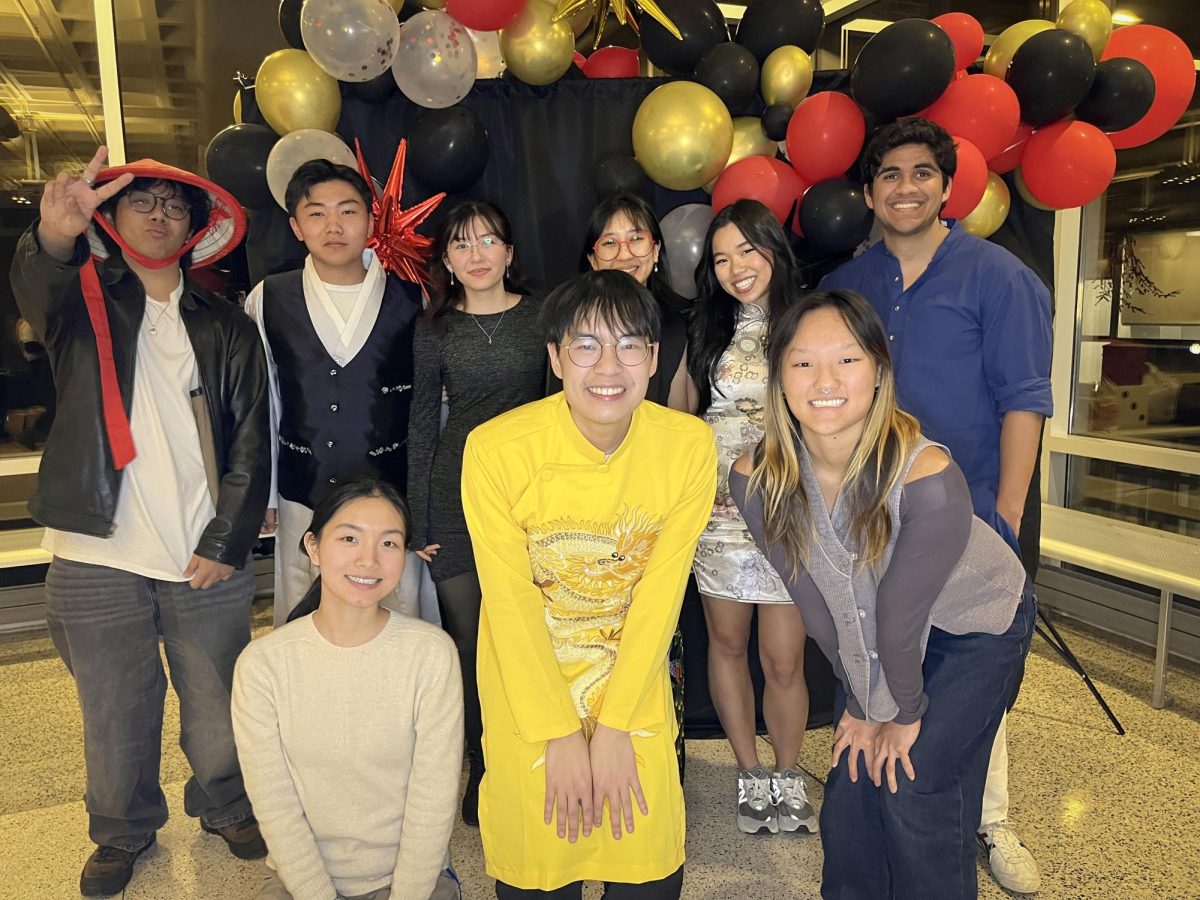
On Saturday, March 28, over a hundred students gathered in the Kagin Commons Ballroom for the Annual Asian, Pacific-Islander and Desi in America (APIDA) Gala. The event featured performances from groups across the Twin Cities’ Asian communities.
The first group to perform was the Chinese American Association of Minnesota (CAAM), from the St. Paul-based Chinese Dance Theater (CAT), the oldest Chinese dance company in the Midwest, which has performed for over 30 years. CAT’s stage time was split into three performances: two solos and one dance featuring a trio.
Following, Rohini Chatwani ’29 and Richa Raja ’29 performed a Kathak dance, a traditional North Indian classical dance that integrates storytelling into the performance. Though the two learned alongside each other at Katha Dance Theater in Minneapolis, the APIDA gala was their first time performing together for a Macalester audience.
“South Asian dances and classical dances are really beautiful, and I think sometimes they tend to be a little bit under-represented too,” Chatwani said. “…We just took it as a really good opportunity to be able to showcase something we’ve been learning for a long time.”
Members of Macalester’s pan Asian dance group X-ERTION offered attendees a glimpse of its scheduled show in May. Scarlett Liu ’26 and Rosella Guo ’28 danced to a mash-up of “Boss Bitch” by Doja Cat and “Run the World (Girls)” by Beyoncé.
Alum Christine Li ’25 was the final dance performance. She performed two Chinese dances — the first a traditional Dai ethnic dance, and the second a contemporary one, which integrated martial arts into the performance.
Li’s performance resonated with Co-President Paul Nguyen ’26, who admired the versatility of her dances.
“One of the most memorable was probably Christine Li,” Nguyen said. “I just really felt moved by her dance. I really appreciate how she mixed up athletic sports and Asian culture.”
For Nguyen, attending events such as this and the Annual Night Market helped him find a place at school when he first came to Macalester.
“When I went as a first-year, I remember thinking, ‘Oh my gosh, Macalester appreciates my culture and they know how to celebrate it in the right way.’”
Now that he’s on the board, it’s important for him to offer that opportunity to more students.
“I’m really thankful that I’m the one who’s pushing [these events] out to serve other Asian students.”
The event also featured a poetry reading from English and Creative Writing professor Michael Prior. He discussed and read poems from his upcoming poetry collection about the American and Canadian Japanese internment camps in WWII, where his grandparents were interned.
“My grandfather is 94, he might outlive us all, but if he doesn’t, soon there won’t be anyone who actually went through this around,” Prior said. “So what’s the responsibility, then, for the younger generations? The caretaking, shaping of collective memories. I think this is something we should all be thinking about in relation to the communities we come from. How do we shape, how do we care for, how do we maintain the memories that are important to that community?”
The reading stuck with many of the attendees: “I really loved Michael’s [performance],” APIDA Co-President Sydney Ohr ’26 said. “I think having a celebration like this is fun, but it’s also important to hear the stories of past Asian Americans and it’s really rewarding to hear that part of history retold.”
The reading also resonated with Outreach Coordinator Luukas Cho ’28: “I actually wrote down a quote of his because I really liked it: ‘Memory is identity.’ I thought that was really powerful.”
APIDA is a Pan-Asian affinity space that aims to serve all Asian Macalester students and bridge the more specific cultural orgs. They recently tweaked their name to be more inclusive, changing “American” to “in America” because of international Asian students who wanted to be involved. APIDA leaders also seek to support smaller on-campus orgs.
“At APIDA, we get a lot of funding, we know that it’s important and that a lot of other orgs might not get as much as we do, [so we’re] able to support them, and they’re also a great help to us,” Ohr explained. “We always appreciate when we can do a collaboration with all the other orgs here.”
During their Annual Night Market, which will be held on April 3 this year, orgs set up tables to highlight their own cultural foods.
“Everybody comes together,” Cho described. “Sometimes groups will cater. Sometimes groups will make their own homemade food. … It’s like a real night market in Asia. It’s really, really awesome, especially because it’s the only event where all these smaller Asian ethnicity specific groups come together in one place. And that’s really great to see, especially since APIDA is overarching.”