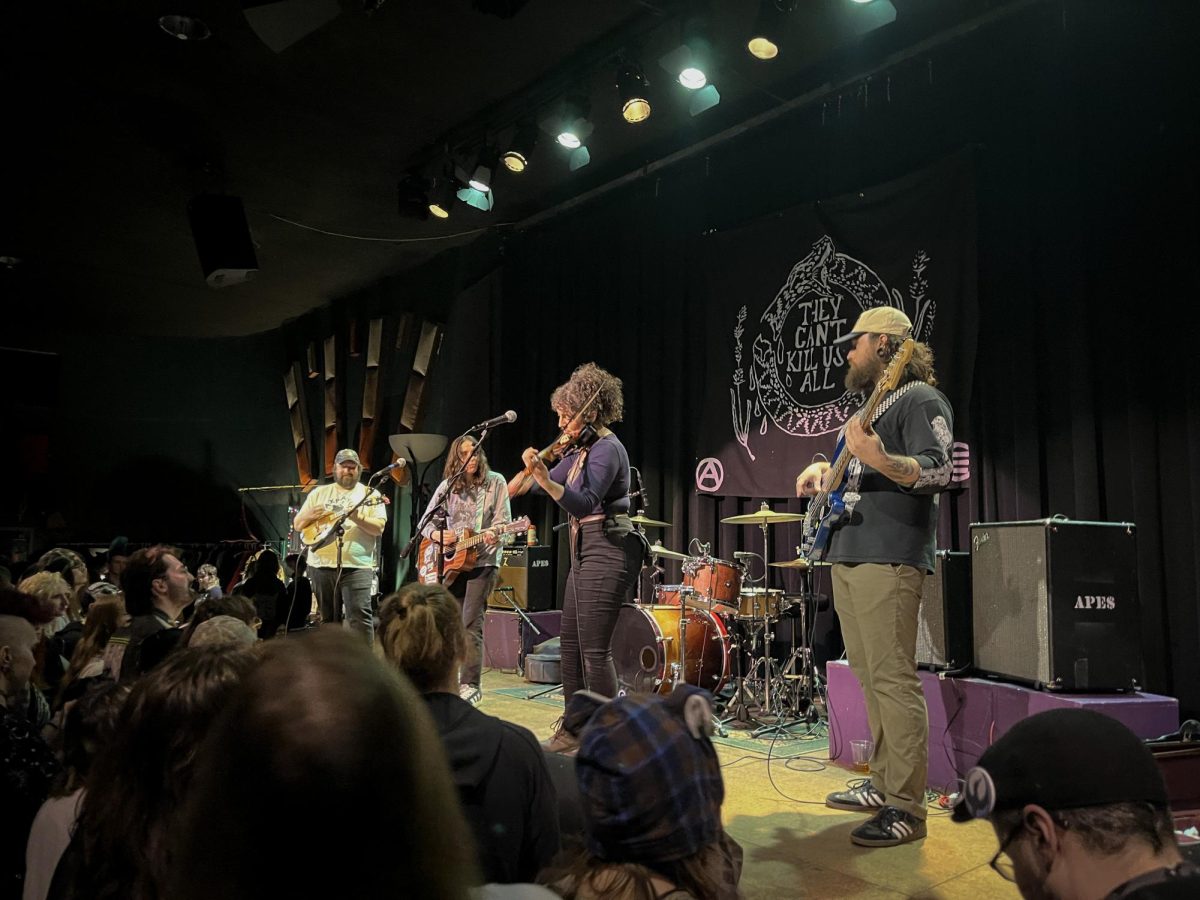
On Feb. 24, Apes of the State took the stage at The Cedar Cultural Center in Minneapolis. The punk band from Pennsylvania was joined by Rent Strike, a trio from Michigan. The show was the fifteenth stop in a tour celebrating the tenth anniversary of Apes’ 2016 album “This City Isn’t Big Enough.” Additionally, Open Market MN and Twin Cities Trans Mutual Aid were fundraising at the event.
Both Apes of the State and Rent Strike belong to a genre of music called “folk punk,” which blends the sounds of folk and punk while drawing on both genres’ shared history of music activism. Deeply inspired by the work of Woody Guthrie, folk punk is characterized by intense vocals, politically-charged lyricism and a community-first, unabashedly leftist ethos.
Rent Strike played a mix of songs from across their catalogue. This was my first exposure to their music, though they have been around for over a decade. Rent Strike is the brainchild of front man John Warmb, whose songwriting is rich with piercing wit and striking symbolism. At first, I was put off by their abrasive sound, but I was eventually won over by Warmb’s emotional singing and irreverent sense of humor. I particularly enjoyed their cover of Mischief Brew’s “Free Radical Radio Fever” and their unreleased song “The Scouring of the State.” The latter is inspired by “The Scouring of the Shire,” the penultimate chapter in “The Lord of the Rings,” wherein Frodo frees his home from authoritarian control. Warmb’s love for Tolkien’s work is evident in his lyricism, which lends the song a touching air of sincerity.
After their set ended, Rent Strike handed the microphone to Rob Taxpayer, lead vocalist of local punk band The Taxpayers. Outside of the band, Taxpayer is a Minnesotan public school teacher. He told the audience that 32 of his immigrant students faced eviction as a result of Operation Metro Surge — President Donald Trump’s immigration enforcement operation in Minnesota — as their parents had missed work to avoid deportation. To raise money for his students, Taxpayer led a “public auction,” wherein audience members contributed funds to collectively buy a painting by Pittsburgh artist Derek Zanetti. The painting is to be hung at Duck Duck Coffee in the Powderhorn neighborhood of Minneapolis.
Taxpayer was joined by representatives from Open Market MN, a food collective that hosts community meals and open markets across the Twin Cities. He noted that all funds raised at the show would be split evenly between his students and Open Market.
Next, volunteers at Twin Cities Trans Mutual Aid (TCTMA) went onstage. TCTMA reminded attendees that they were tabling to fundraise in support of essential needs for transgender Minnesotans next to the merchandise booth. They also announced a benefit show with The Taxpayers on April 3 at Underground Music Venue in North Loop.
Then it was time for the headlining act: Apes of the State. Hailing from Lancaster, Pa., the band consists of four members: April Hartman (vocals/guitar), Mollie Swartz (electric violin/bass), Ian Cornele (bass/drums) and Dan Ebersole (mandolin/guitar).
Hartman began writing songs in 2015 while recovering from a heroin addiction. She is now eleven years sober. In 2016, the newly-formed Apes of the State released “This City Isn’t Big Enough.” With this album, Hartman’s music hobby “spiraled out of control and led to a lot of beautiful moments,” as she remarked onstage.
“This City” touches on a wide range of subjects, including addiction, grief, mental illness, community, activism, love and heartbreak. I discovered it almost by chance, while browsing an internet forum during my sophomore year of high school. I was an angsty teenager coping with pandemic-induced isolation, and Hartman’s raw vocals and vulnerable songwriting gave me the emotional outlet I desperately needed.
By the end of high school, I had moved onto other albums, but felt compelled to revisit “This City” when this show was announced. Imagine my surprise when I found myself singing along to lyrics I hadn’t heard in years, and connecting with the music on a deeper level than I ever had before. Upon taking the stage, Apes of the State played their 2023 song “They Can’t Kill Us All,” before launching into a full rendition of “This City Isn’t Big Enough,” the first half of a two-set performance. What ensued was nothing less than an emotional rollercoaster, as the band ping-ponged between protest anthems, love songs and personal reflections.
Of this first set, three songs stood out to me: “Strangers,” “Plate Glass Apology” and “I Listened.” “Strangers” is an ode to everyone who helped Hartman on her recovery journey without knowing it. The tenderness of Hartman’s live singing made refrains of “I’ll love you til’ you love yourself” hit harder than they ever had. “Plate Glass Apology” is a cathartic break-up song that deftly portrays many shades of anger and sadness. It inspired an excellent mosh pit. “I Listened” is a sensitive love song that sounds practically made for live shows, featuring punchy verses great for screaming with a crowd of strangers.
After finishing the album, the band took a brief intermission, swapping their acoustic instruments for electric ones for a second batch of songs. This time, Apes played a mix of songs from 2019’s “Pipe Dream” and 2025’s “What’s Another Night?”
During “Toothache,” an energetic love/hate song, the band was joined by Indianapolis musician Dana Skully. Skully and Hartman harmonized with each other, turning the song from a frustrated solo into a heartsick duet.
The band closed with their latest album’s title track, a life-affirming celebration of resilience and growth. At the end of the song, Hartman performed a stage dive into the teary-eyed crowd while shouting the final line: “Over up and onwards, I’ve made it all these years so what’s another night!”
But the audience wasn’t ready for the night to end and demanded an encore — much to the band’s surprise. Hartman said Minneapolis was the first city on the tour to ask for one. Apes obliged, launching into a second rendition of “Plate Glass Apology” that was both literally and figuratively electric. After standing on the sidelines all night, I decided to jump into the pit. The room was submerged in adrenaline-fueled euphoria. As I moshed, my body collided with many others, joyful energy radiating from the points where our clothes had touched.
In Feb. 2025, I covered a different punk show for The Mac Weekly. Reflecting on the experience, I wrote that the theme of the night was “healing,” as the show provided an outlet for artists and attendees coping with a surge in hate and discrimination following Trump’s re-election.
Over the following months, the Twin Cities punk community began to recover. Then came Operation Metro Surge, which turned the sparks generated by the political turmoil of 2025 into a raging fire, reactivating dormant networks of mutual aid and advocacy. Minneapolis punks were done licking their wounds — they were ready to act, and act they have.
The theme of tonight, then, was not healing: it was fighting. Protest songs were punctuated by raised fists, and both bands repeatedly joined the audience in chanting “F–K ICE!” Rage dominated the room, but it was the sort of rage that emerges from a deep love. It was this rage that drove attendees to donate hundreds of dollars to mutual aid funds, to shout declarations of friendship at the top of their lungs, to hold onto each other tight and not let go. Anger is not something to fear or avoid. Anger is the tool we must use to conquer this moment, so we can lead with love come tomorrow.