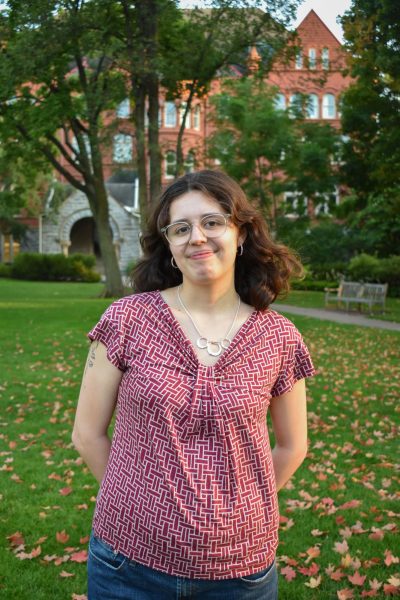
This Tuesday, St. Paul held elections for city mayor. At 12:07 a.m. on Wednesday morning, State Rep. Kaohly Vang Her was declared the winner by the Ramsey County Election Office after second-round vote reallocations were determined. Her narrowly-defeated two-term incumbent Mayor Melvin Carter. Her currently represents Macalester-Groveland among other neighborhoods in district 64A in the Minnesota House of Representatives. She will also become the first woman and first person of Hmong descent to hold the office of mayor in St. Paul.
St. Paul’s contested mayoral election saw five candidates vying for the mayor’s office: Incumbent Mayor Melvin Carter, State Rep. Kaohly Vang Her, scientist Yan Chen, small business owner Mike Hilborn and self-declared urbanist Adam Dullinger. Voters cast their ballots through ranked choice voting, where the voter ranks their candidate preferences instead of selecting only one candidate, and voting is tabulated in multiple rounds.
According to Ramsey County, Her received 47.76 percent of second-round votes with Carter trailing with 44.99 percent and 7.25 percent of ballots inactive. About 40.44 percent of registered voters participated in the election.
According to results from the Minnesota Secretary of State’s office, Carter narrowly won first-choice votes in the precinct encompassing Macalester’s campus. Carter received 372 first-choice votes while Her received 342 votes; all other candidates combined received 108 votes. However, other precincts in the Mac-Groveland and Union Park neighborhoods went narrowly for Her.
During the mayoral forum held at the Weyerhaeuser Memorial Chapel last Thursday, Oct. 30, Her said that she challenged Carter in August after seeing a lack of outreach to voters and campaigning in this election.
According to the press statement Her gave after winning, she said, “I got into this race after the assassination of my good friends Mark and Melissa Hortman over the summer. Melissa always told us ‘These seats don’t belong to us, we need to go out and earn the right to represent people.’ Tonight, we honored her legacy.”
The main focus of the Her campaign was that St. Paul is facing significant issues that people are not aware are happening.
“Our city isn’t doing well,” Her said. “There are a lot of issues, [including] that we have to actually build more deeply affordable, abundant housing, we have to make sure that our economy is thriving, there has to be safe neighborhoods, and we have to defend our neighbors.”
First-time voter Violet Armstrong ’29 was initially underinformed about the St. Paul mayor’s race. However, after discussing with her friends about the candidates’ platforms, Armstrong decided to rank Her as her first choice candidate.
“I put Her as the first choice [because] she was a candidate that I thought really stood for what I wanted to be voting for,” Armstrong said. “I thought it was very interesting that St. Paul has not had a female mayor before, and I really liked what she was standing for in terms of clarity…I know a lot of the other candidates were somewhat vague in what they were standing for.”
Sol Landman-Feldman ’26 said that he ranked Her as his number one choice because he would like to see a change in leadership to help create more urban development and address safety concerns in St. Paul.
“I think Carter has been doing a good job… but I think there’s still some unresolved issues, especially with downtown and with the Midway neighborhood, that I’d like to see more progress on,” Landman Feldman said.
Carter had sought a consecutive third term as mayor. According to Carter, his two terms were marked by instability within St. Paul, the Twin Cities and the United States, due to multiple factors including the COVID-19 Pandemic, unrest after the murder of George Floyd and the looming threat of President Donald Trump’s federal policies.
Carter had spent election day hopping between different college campuses in St. Paul, including Macalester.
“The biggest issue we’re hearing from folks [at Macalester] is the anxiety about all the chaos that the President is intentionally causing our country,” Carter said in an interview with The Mac Weekly.
At the forum, Carter said that St. Paul has been on the rise under his mayorship and is willing to try innovative tactics and be a national leader on initiatives, such as being the first city to have an electric vehicle carshare program and to put $50 into a college savings fund for each baby born in St. Paul.
“I put Carter as my number one pick,” Alex Horowitz ’29 said. “I met him…and I asked him [about] a lot of issues, and there were some things that I was a little bit disappointed in. But on the whole, I think his stances on development, homelessness and the drug epidemic are stances that [which] I would agree with.”
While Carter and Her were the most high-profile candidates in this race, political newcomers also ran for mayor.
Chen, a scientist and researcher, ran on re-examining the role of St. Paul’s city services through the lens of a political outsider and learning to understand what specific work needs to be done in the city.
Hilborn, a West 7th business owner, ran for mayor to preserve the interests of St. Paul business owners at City Hall. He decided to run after his landlord increased his monthly rent to a price unaffordable for his business to stay in St. Paul and believes that St. Paul taxes are too high.
Dullinger, an engineer and the youngest candidate in this race at 29 years old ran on a self-described urbanist platform that emphasized making St. Paul a city where people want to live and work and revitalizing bikeways and public transportation. Dullinger also refused to receive any donations or endorsements in the campaign to restore accountability in politics.
During the election campaign, candidates sparred over several hot-button issues that have divided voters in St. Paul.
Summit Avenue Bikeway
In 2023, the Metropolitan Council passed a plan to reconstruct Summit Avenue to accommodate a new bike trail. While Summit Ave. currently has a bike lane, proponents of the plan believe that the bike lane is poorly constructed and does not properly accommodate bikes.
The Summit Ave. Regional Trail would lead to Summit Ave. being completely reconstructed in addition to accommodating the new bike trail.
Opponents of the proposed plan believe the bike trail would cause more harm than good. This includes cutting down around 200 trees and spending $100 million dollars to reconstruct the street leading to fears of additional property taxes to fund the project.
During Macalester’s mayoral forum, Carter and Dullinger said that they were in favor of the plan with Chen agreeing that the eastern half of Summit should be reconstructed. Hilborn said that he was opposed to the reconstruction of Summit and proposed that a bike lane should be added alongside Interstate 94. Her did not give a direct answer about the reconstruction plan but stated in a prior forum that she would rather see a bike lane being constructed in a less affluent area.
Development in Midway and Downtown
Since the stay-at-home orders due to COVID-19 pandemic, as well as the unrest after the murder of George Floyd, both the neighborhoods of Midway and downtown St. Paul have been of significant concern. This includes a lack of foot traffic in downtown and businesses, such as the Cub Foods on University Avenue, which closed in August.
Most of the candidates believe that these areas are currently going through an economic downturn and substantial work needs to be done to fix these areas’ struggles.
Chen and Hilborn believed that solving crime or the perception of crime would help to incentivize businesses to grow in St. Paul and, in turn, help revitalize those areas.
On a similar note to Chen, Her believed that the key to helping revitalize these neighborhoods is to help support growing small businesses, specifically from immigrant and refugee communities.
Dullinger said that the reason why these St. Paul neighborhoods are struggling due to the nature of St. Paul being a highway-dependent city and that the proposed redevelopment of the Grand Casino Arena (formerly known as the Xcel Energy Center) would be wasteful governmental spending.
Carter’s view stood in contrast to the other candidates. “It’s springtime in both the Midway area and in downtown,” Carter said.
Carter cited the recently started construction to develop the land surrounding Allianz Field along University Ave. In addition, Carter said that the proposed renovation of the Grand Casino Arena will enable downtown to establish housing as a big pillar in that area.
“For me, one of the bigger things [in this election] was the plans of the candidates of what to do for the downtown area,” First-time voter Aaron Carr-Pellow ’29, who ranked Carter as number one, said. “The different choices that they all had concerning [downtown] have a lot of chance to impact a lot of other issues in St. Paul.”
Affordability
One of the main concerns this election cycle for St. Paul voters was the cost of living going up in the city, which includes prices of everyday goods and services as well as housing costs.
Hilborn believed that the best way to bring down the cost of living is to lower both St. Paul’s 9.88 percent sales tax and St. Paul’s property taxes, as well as that the city needs to stop funding projects that Hilborn views as wasteful, such as the reconstruction of Summit Ave. Similarly, Chen said that for the city to become more affordable, St. Paul needs to look at its government’s programs and examine them for “effectiveness and efficiency,” as well as lower property taxes.
In contrast, Carter said that investing more into government projects for public housing, infrastructure and local businesses is the best way to make St. Paul an affordable city.
Dullinger believes that the only way for St. Paul to become affordable is for the city to emphasize transportation affordability and that 40 percent of taxable income for the city goes toward funding public transportation projects.
Her said that St. Paul must collaborate with the state government to create more affordable housing projects in the city and that the greater supply of housing will cause prices to go down.
Her will be sworn in as mayor on Jan. 1, 2026 and will have three years to get her agenda through instead of the usual four because St. Paul moved its next mayoral race to be during Presidential election years.